— Science Goal 3
Cosmic Ecosystems.
How do galaxies acquire, retain, and recycle matter?
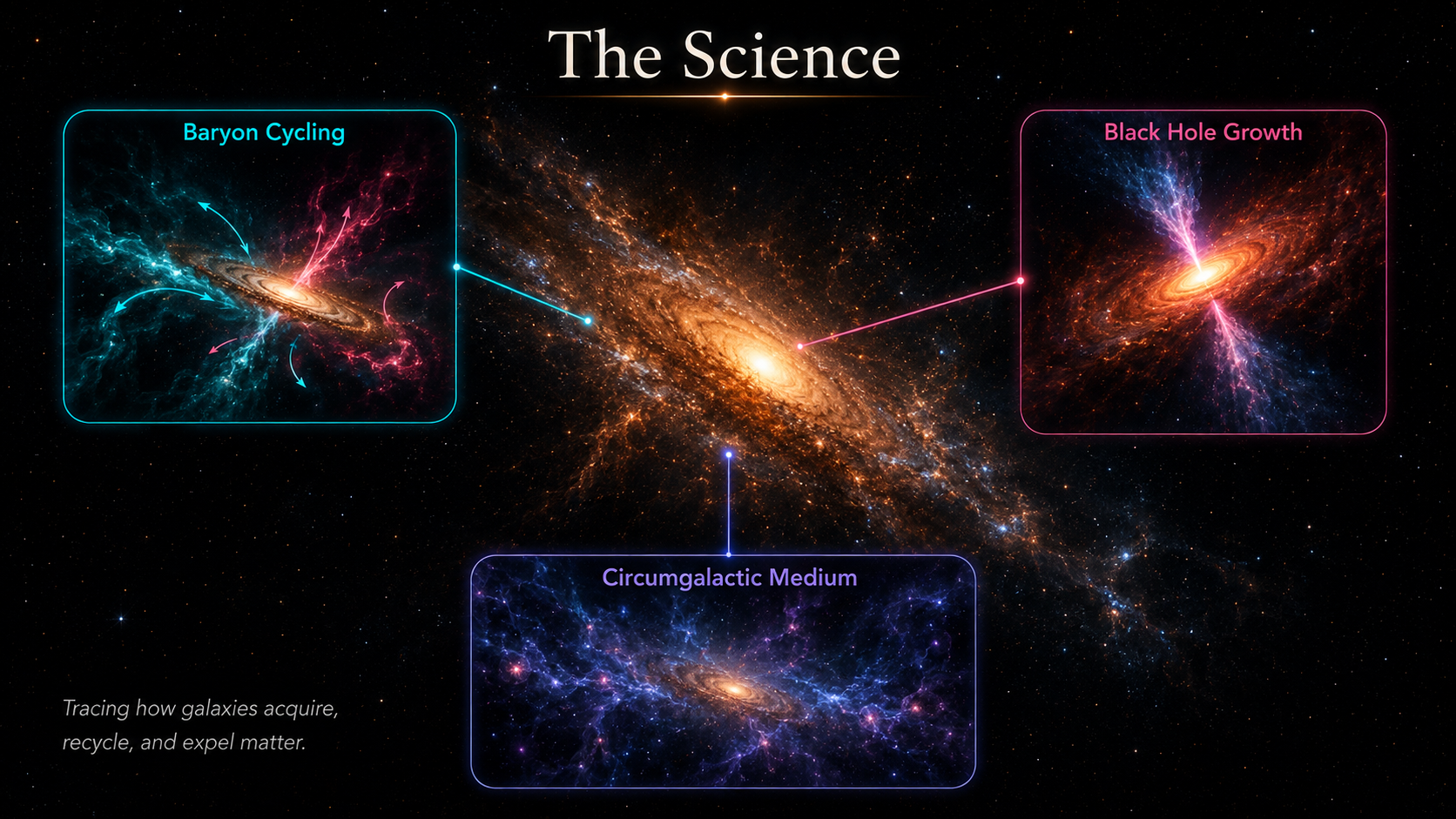
Galaxies grow by drawing gas from their surroundings. Stars and black holes then return
matter, metals, and energy to the interstellar medium and circumgalactic halo. Some of
that material escapes. Some remains suspended in the halo. Some cools and returns to fuel
another generation of star formation.
This baryon cycle connects the smallest structures within galaxies to the cosmic web.
Current observations usually isolate only one part of the cycle. CELESTE will connect the
star-forming disk, the sources of feedback, and the surrounding gas reservoir within a
common spatially resolved framework.
Observations of dwarf galaxies, massive galaxies, active galaxies, and their environments
will establish how the baryon cycle changes with galaxy mass, evolutionary stage, and
environment. Nearby resolved stellar populations will provide an archaeological record of
how these processes operated over time.
CELESTE will
- Map inflowing, outflowing, and recycling gas within and around galaxies.
- Connect individual sites of star formation and feedback to galaxy-scale gas transport.
- Measure how mass, metals, momentum, and energy move between galaxies and their halos.
- Determine which galaxies retain their baryons and which lose them.
- Compare baryon cycling in dwarf galaxies, massive galaxies, and active-galaxy hosts.
- Resolve stellar populations in nearby galaxies to reconstruct their histories of star formation and chemical enrichment.
- Test galaxy-formation simulations using spatially resolved measurements rather than integrated averages.
The Result
CELESTE will establish how galaxies obtain the material required for growth, how feedback redistributes that material, and how much ultimately returns to form new stars and black holes.